The Documentation Burden Behind Clinical Conversations
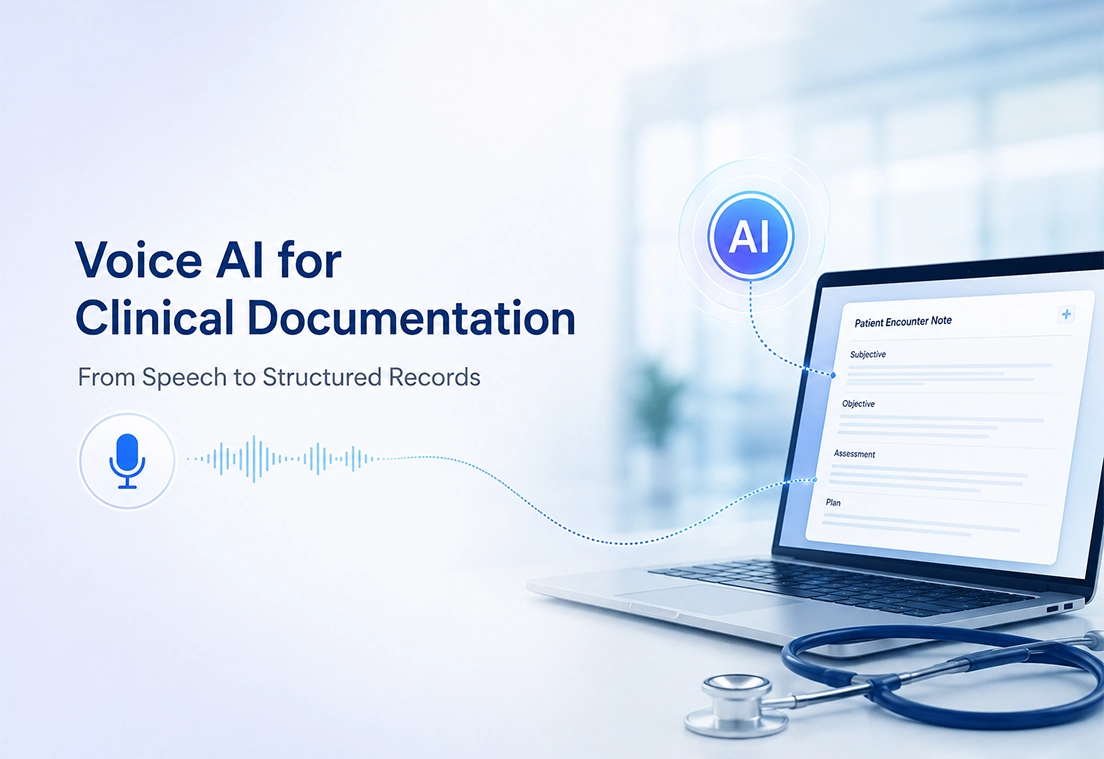
Documentation of patient encounters is essential and comprehensive documentation can be a burden to clinicians. Continuous typing, navigating EHRs and documentation following consultation often are required to record symptoms, clinical findings, assessments, and treatment plans. This can reduce attention during patient interactions and extend clinical work beyond scheduled hours. Voice AI offers another approach by capturing natural clinician patient conversations and converting relevant information into structured clinical documentation. It's not meant to replace clinical assessment, but it helps to eliminate repetitive documentation tasks and lets clinicians review and approve the clinical record.
Why Clinical Documentation Is Still a Challenge for Clinicians
- Manual Documentation : The clinician is responsible for documenting the patient encounter, including symptoms, findings, assessments, and treatment plans.
- EHR Screen Dependency : There is a competition for time between direct patient clinician interaction and frequent typing and EHR navigation.
- Repeated Note Taking : Entering into the clinical information over and over again for routine consultations adds administrative effort.
- After Hours Documentation : Documentation tasks may continue outside of the clinical hours and add to workload
- Effect on Clinician Attention : When documentation is a concurrent task, it can add to cognitive load and decrease the amount of time that can be devoted to the patient.
How Voice AI Turns Clinical Conversations Into Structured Notes
Voice AI transcends the boundaries of traditional dictation to revolutionize clinical documentation. An Ambient AI Scribe can record the natural clinician patient conversation and convert it to structured clinical documentation rather than having to dictate specific commands or follow rigid templates.
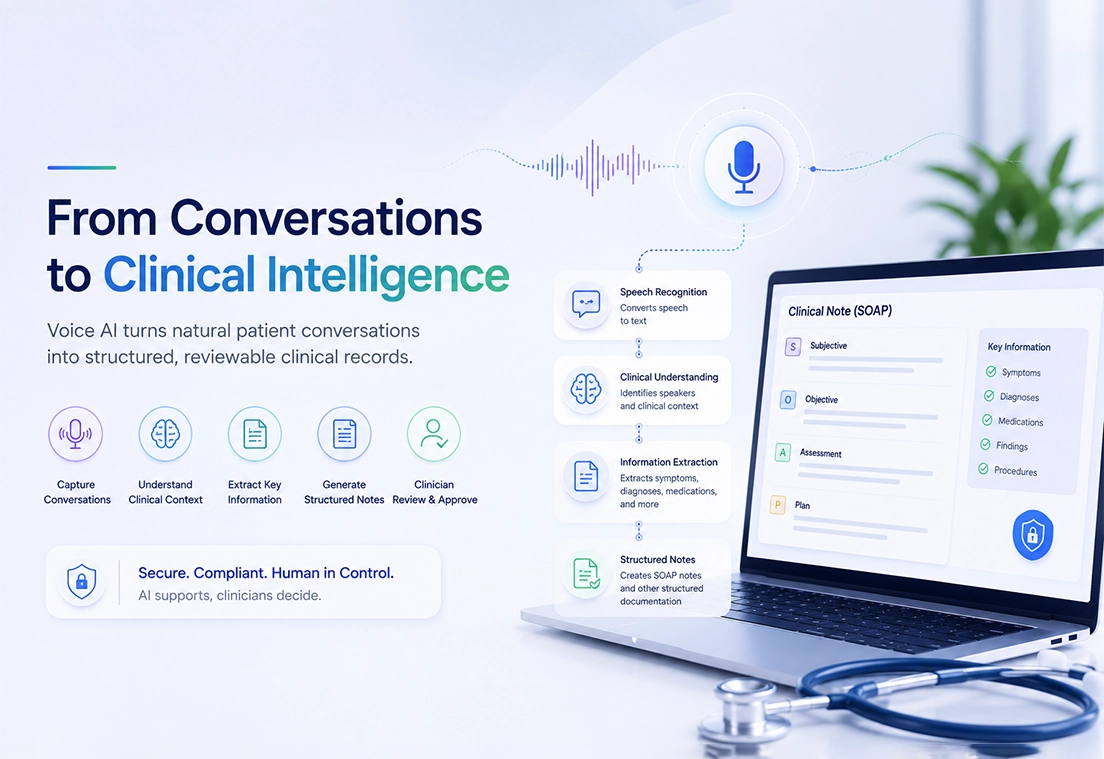
- Clinical Conversation: The system captures the natural dialogue between the clinician and patient during the consultation.
- Speech Recognition: Automatic Speech Recognition converts spoken conversation into text while supporting clinical terminology and, where available, multiple languages.
- Clinical Understanding: Speaker diarization distinguishes between participants, while clinical NLP identifies relevant medical information within the conversation.
- Information Extraction: The system identifies details such as symptoms, diagnoses, medications, clinical findings, and procedures.
- Structured Note Generation: An LLM organizes the relevant information into a structured clinical note, often using formats such as SOAP documentation.
- Clinician Review: The generated note becomes a draft for the clinician to review, edit, and approve before it is incorporated into the clinical record.
This workflow shifts clinical documentation from manual transcription toward AI-assisted structured documentation, while keeping clinical judgment with the healthcare professional.
From Transcription to Structured Clinical Record
Simply converting a clinical conversation into text does not create a usable medical record. Clinical documentation AI adds another layer by identifying relevant medical information and organizing it into structured documentation that can support clinical workflows.
- Clinical Information Extraction
- Structured Clinical Notes
- EHR Ready Documentation
- Coding Related Information
- FHIR Integration
How Voice AI Changes the Clinical Documentation Workflow
Voice AI can influence clinical documentation at several points in the clinician's workflow. Reported implementations indicate potential improvements in documentation efficiency and clinician experience, although outcomes can vary by system, specialty, and implementation.
Reduced Documentation Time
AI-generated first drafts can reduce repetitive typing and the time required to prepare clinical notes.
Less After Hours EHR Work
By supporting documentation during the clinical encounter, Voice AI can help reduce the amount of EHR work completed after scheduled hours.
Reduced Screen Dependency
Capturing the conversation can reduce the need for continuous typing and EHR navigation during consultations.
Greater Clinician Patient Interaction
Less attention directed toward documentation can allow clinicians to maintain greater focus and engagement with patients.
Improved Documentation Efficiency
Automated capture and organization of relevant clinical information can streamline the documentation workflow.
Potential Operational Benefits
Time saved through documentation support may contribute to improved workflow efficiency and patient throughput, depending on how the technology is implemented.
“Turn every clinical conversation into structured intelligence that saves documentation time, strengthens clinical workflows, and keeps clinicians focused on patient care.”
Why Human Review Matters in AI Clinical Documentation
- Accuracy and Omissions : AI-generated notes can miss information or introduce incorrect details, making verification necessary.
- Hallucinated Information : Generative AI may produce information that was not present in the original conversation, so clinicians need to validate the content.
- Clinician Review and Editing : The clinician should review, correct, and personalize the generated note before approving it as part of the clinical record.
- Clinical Responsibility and Patient Privacy : The clinician remains responsible for the final documentation, while appropriate consent, privacy safeguards, and governance should be maintained.
From Spoken Conversations to Intelligent Clinical Records
Voice AI moves clinical documentation beyond basic speech to text by converting spoken clinical information into structured, reviewable records. When integrated with digital healthcare workflows, it can reduce repetitive documentation work while helping clinicians maintain greater focus on patient care. Human review remains essential to verify the accuracy and completeness of AI-generated notes
Aosta BackBone AI supports connected healthcare workflows, including Voice Recognition and Digital Notes, helping hospitals bring voice enabled documentation into their broader digital clinical environment. The future of clinical documentation is not simply about capturing what is spoken. It is about turning clinical conversations into structured, reviewable, and connected medical records